
About 2 years ago my technologically inept local supermarket introduced a mobile app, allowing me to scan the articles in store and checking out by scanning a QR code. Nothing new I hear you say, my supermarket offers the same service much longer than that. Agreed, these services have been around some time, but that’s not the point right now. What matters — and what this article offers an approach for — is the change in my behaviour as a user and my thinking about the vendor’s market position by using such a service. Shopping for groceries is not something I specifically enjoy, but I can’t say I specifically object to it either. It often feels like time off from the regular grind of a day at home. What I do resent however is standing in line with a full trolley, unloading it on the register belt only to load it into the cart afterwards again, barely being allowed the time to do so. It just seems complete madness to me.
Thanks to the mobile app though, I just scan the items as I go along and pay at the checkout with the swiftness of mobile banking. Done, no need to stand in line, out in a whip! As an added bonus, I get to pass by everyone in line because there is a special line just for people using the app. It’s as if we get a special reward. This relatively small adaptation to the process (although I sincerely do not underestimate the architectural layout and implementation behind it) taps perfectly into the basic wants and need of humans, while relieving us from the most irritating tasks.
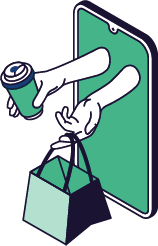
Yet it can be even more efficient, I hear you think. In a world where e-commerce and at-your-door-delivery is already the standard, it feels almost inconceivable you would do your shopping the traditional way at all. Just imagine the time and energy you spend between initially thinking about shopping and getting the products stored in the right location in your house. I fully agree. As for me — even though I often do my shopping in the traditional way — e-commerce has become the primary mode of shopping. Yet it’s not always the best way and for a lot of people, it’s not the way at all. Shopping remains a social event, or at the very least a sensory one. The occasional look-in-the-eye of a passer-by, the friendly chat with your kid’s teacher you run into, the physical feel of that exotic papaya before you buy it, it all adds up to the reason we still do shopping the traditional way. The logical efficiency of online shopping never compensates for the rich sensory experience offline shopping can offer, at least not yet for the majority of people. Who ever said people were logical anyway?
The above example could translate into pretty much any service we deal with. The point is we’re seeing changes in every aspect of our lives. How will organizations today – are they to remain relevant tomorrow – interpret these changes to their advantage? This article is about that. It addresses you, running or working at an organization, looking for ways to entice your users and thereby increasing your market position. Although the task at hand may seem dispiriting, the principle to get it right is surprisingly easy. It just requires a basic human feature we all possess but often forget to apply.
The very nature of change (and so of every single aspect of life) is that it changes. It morphs into different shapes, based on the incidental interactions that shape our existence. Change therefore is the essence of life. Facing this condition with your organization requires out of the box thinking, bold decision-making and fearless determination; combined with a team of believers, a thirsty crowd of consumers, a spacious budget and last but not least, plenty of time on your side. If this sounds like your organization, I envy you, but I doubt it. Chances are your daily aim is to maintain and get the job done. However, completing tasks within the timeframe you aimed and hoped for is mostly a utopy you simply cannot attain. You are obliged to deal with unforeseen situations where things don’t go as expected. Situations that frustrate you because they curb your flow or hurl you back in time. Yet, you deal with it because you simply have to.
Next to that, there’s people. You can have the best plan fit together, but you can’t plan people. Not all the time. Your right-hand colleague falls sick. You have a blowout with a division manager, who later on decides to leave the company pursuing a new challenge, leaving you in the lurch. Even you, yourself, thinking you’d run every mile, may feel tired and confused. When you’re a business owner with an organization that is built on years of legacy processes, change is brutal and will require at least some of the ideal model ingredients mentioned above. And yet, your users expect a certain degree of change; a certain degree of evolution. You can have excuses for your inability towards change and evolution but your customers aren’t as patient. They expect action. Whoever said digital isn’t just a thing anymore, it’s everything?
When called for a solution to these challenges, the most conclusive answer is innovation. But what is innovation if not the hyped umbrella concept for everything concerned with change? Innovation can mean a lot. You’re innovating when you buy the newest line of register tellers or invest in extra charging spaces on your parking lot. For the sake of this article however, I’ll frame the word ‘innovation’. It means getting up to speed with reality by using creative methods to implement new technologies and business processes, with the clear goal of providing your customers with a better experience. In that sense, innovation can be done in or out of the box. It can be profitable to improve on a basic feature of your organization — outperforming the competition — or it may be wise to remodel it in a way no other organization has done before — leaving the competition behind. Whatever the case, innovation is not a layer. It’s not a cloak you put on, hoping the wind of change won’t affect you. Innovation is a mindset, rooted deep within your company. It needs to be nested within its DNA. As such, it should revolve around your core activities. A car insurance company looking to innovate by offering personalized windshield covers is unlikely to succeed. One that innovates through well-thought algorithms understanding your driving profile and optimizing your behaviour through contextual advice is.
The Innovator’s Dilemma’ of Clayton Christensen is regarded as one of the most influential management books of all time. Christensen writes about a few sectors, one of them being the Disk Drive sector. Disk Drive companies that produce a top selling product were generally companies that were well-managed, well-structured, or have matured so over the years. Whenever they released an update, they did so driven by the same proven technique of managing and releasing products, by incrementally improving their product. After all, they knew their clients’ needs and therefore knew exactly what they wanted. Simultaneously, early disruptors came along and released a product that was initially inferior in specs: a lower storage and no apparent market to buy their products. These were startups with practically no management and no experience, releasing a menial product. It imposed no threat so they were initially disregarded. But then something interesting happened: even while these products proved seemingly substandard, they targeted a growing market the big companies didn’t notice. They didn’t notice it, because they were too focused on what their main clients wanted. There was a whole market of consumers out there who were increasingly on the move, requiring smaller devices to carry around and — especially for the context in which they demanded them — didn’t really require all that much space after all. They needed to catch a train and wanted to continue writing their word document on the go. These products proved to be the right fit for the right public and the right time (all the more so with the power of internet reaching wider masses). These smaller startups detected the need, because they weren’t tied to big clients nor investors dictating their moves. They had no set company rules on how to conduct business. They were free to flow where the market guided them and took advantage of listening to that market. Meanwhile the big companies, although they basically had done nothing wrong and followed every acceptable step, were left standing. Some of them managed to get on track, many died down due to a slow speed of change. Incrementally changing their products proved to be a wrong strategy.
In light of how we all conduct business on a day-to-day basis, these changes don’t manifest themselves so predominantly. Probing Christensen’s theory, we should question the irrelevance of incremental change. Today it seems the most rational choice to make. Life doesn’t jump in years, it goes from day to day. Christensen does however expose an underlying pattern of transformation that’s steadily unfolding, one which forces us to reorganize one way or the other. It’s this flooding pattern that drives you to challenge your strategy in the long run. How (fast) will your organization shift gears? Do you follow proven formulas, accumulate slight alterations, scale up to more agility or perform a complete factory reset? Or maybe it’s in the everyday incremental changes that you work towards a sweeping innovation. In order to substantiate this hard message, you best start small and drill down to the essence. What is the core of your organization’s message, who are you doing it for and especially why? Clarify this and then scale up. At every level of scaling, apply constant empathy and question the essence. In this article I will guide you to start easy, by thinking design, not as a process of giving form to experiences, but as a strategy to building the right DNA of your organization.

Let me first ask you a question Tom Goodwin posed in his book ‘Digital Darwinism’: What would your business look like if it was created today? If you could start over, lose all liabilities and get yourself at the drawing board, how would you design it? Chances are you’d want things simpler. Not only for yourself or the people in your organization, but for your consumers as well. Every one of us craves for simplicity. It’s how we’re wired as humans. In a complex world simplicity is ultimate bliss. Our lives could become much easier as technology benefits us yet it feels more difficult by the day. This conundrum is not only thwarted by the scientific complexity of emerging technologies but largely due to poor design. And poor design is born from a lack of deep understanding of who we are and what we need (let alone of the technology we’re designing for).
Hence your organization keeps having great difficulties formulating the why of its existence. Think about it. We build things we don’t particularly know how to use, we stuff them with all sorts of functionalities and we expect people to go ahead and use them. Take your microwave for example. How many button combinations do you really use? You probably use the same setting over and over. And then your home climate control. You can’t even properly figure out how to set the timer for your vacation. It’s clutter. You want something slick and easy, like a Nest (Google’s answer to usable home automation control). A lot of times poor product design results in us giving up altogether because it’s too complicated. Think of the sheer waste of time and money this generates, not using products or services to its full advantage. I bet that while you’re reading this, you have at least thought the same way about one of your services or products. Surely you can design them better, in order to help your customers better. They don’t need to be your end customers, the kind you accidentally bump into in the street. The people you work with also benefit from better design. Clients, customers, employees,… it’s all of us.

Then what is better design really? How and where does it manifest itself for your business? Lucky for you I am a designer, I will put your mind at ease. First, let’s get one obvious misunderstanding out of the way. Design isn’t limited to the look & feel of your application. It’s not something left to the kind of designer we traditionally associate the function with. It goes deeper than that, much deeper. Design is for all and everywhere. I’m sure I told you nothing new. So let’s get to it! It will take you several minutes and a bit of your imaginative power. Ready?
We’ll start with the reason for your story. Think for a minute: What is your core? What is the foundation your organization is built on? Not so much in what you do but why you do it and who you do it for. Why is what you’re doing important and does it make a difference to the world? If for example you run an insurance company specialized in car insurances your core could be helping people drive around carefree, because in the end you’re not just selling insurance programs, you’re selling a story, an underlying emotion. If you feel confident about your core, see how it might apply in the context of a changing world. When a society of people slowly shifts towards a leasing and sharing economy, how can your offer change with it? Try thinking of your processes upside down for a change. When AirBNB started, they didn’t think of owning hotel rooms as the hotel sector prescribed for all these years. They thought differently: ‘why should we own rooms when other people do and we can just use those?’ The same principle applies for Amazon or a whole range of disruptive companies out there, who dared to look a changing world in the face and challenge it. Again, running your imaginative insurance company, question the classic model of pushing insurance policies to customers. Instead, figure out what’s already there, something that your customers already do or have (including frustrations) and try to start from there.
Now that you’ve trained your brain, let’s do an exercise. So you’re in the insurance sector, but by all means, use your own sector for this exercise. You provide your customers with custom insurance packages and services. Maybe you’re already providing better service than your close competitors. All the more reason you should continue this exercise! Now think about your user. Take one user. By all means, think of any customer you like, imaginative or real. Who is she? What is she doing right now? What makes her happy, what sets her on fire, what makes her angry? Really empathize for a moment. Picture yourself that user, within a certain imaginative but legitimate context. Give your user a gender and a name. Now that you have pictured her, think like her. You’ve hovered over her life, now dive down and try to get into her mind. How does she think? As you’ve cruised a bit with her, depict a situation where she might need a service like yours. You’ve just created a character for your story.
It’s important that you visualize this character (in UX terms called a persona) and that you try to read her emotions, the expressions on her face. One of the reasons companies fail to understand their users is that they don’t connect in a neurologic way. It’s an ancient human trait called mirroring. We connect with other people’s emotions when we actually see them. Reading all the muscular spasms of frustration helps us feel that frustration too, as our brain mimics those moves to better understand what it means but also to have a better understanding of what that person might do next. Knowing what your users will do next is a fantastic advantage over your competition. Don’t start from your own experience. Experience tends to hold you back. What you did in the past (even if it was a success) can’t be held as a guarantee for renewed success. Don’t necessarily look at your closest competitors either. Look further, in places you wouldn’t normally look. As Mark Twain put it: “The best swordsman in the world doesn’t need to fear the second-best swordsman but more some ignorant antagonist who has never had a sword in his hand before; He doesn’t do the thing he ought to do so the expert isn’t prepared for him.”
Now step by step, think how she interacts with your offering. Literally step by step! Maybe her car breaks down in the middle of the road. You already know who she is and how she thinks, how would she react in a situation like that, and what can you do to ease her frustrations? She’s in the middle of a road, doesn’t really know where exactly, her car has broken down, she needs to get to her mother-in-law in time to drop the kids and she’s already running late for a meeting. To top things off, one of the kids is screaming in the back of the car. Furthermore there’s a grey drizzle outside and she hates to get wet because she just spent 10 minutes (she didn’t have) doing her hair. She’s near the brink of devastation. She wants to get out of this misery as soon as possible. She needs to send a message to work explaining that she’ll run late. She then calls her husband even when she knows he can’t really do much at this moment, but she just wants to vent her frustration. Her husband, who’s right in the middle of something, tells her to call the insurance company. Unsettled she puts down the phone. Then she struggles to find the number of your company, not sure if she’ll call the right service. Up till now she has spent 10 miserable minutes she wished she shouldn’t have. Now think how you can ease her pain. It’s your customer, you want to help, and regardless of how you think, there’s not much you can do in any of these situations. Think harder!
How can you tap into an (awful) experience like that and make it more agreeable? It doesn’t matter if the solution you come up with is technically feasible or not, you just need to have some ideal endpoints in mind where you want your user to land and feel taken care of. For instance, what if there could be a way to anticipate the frustration and call her the moment you know her car breaks down, telling her you’re already aware of the situation and ascertain her everything will be ok? “Help will be there in less than 15 minutes. Just stay in the car and relax.” If that sounds like an ideal situation, work towards that. In this phase there doesn’t need to be any commitment yet to pinpoint the exact technologies you’ll use to support your idea. We’ll dive into that in the next step. Maybe you already feel sensors are required but you don’t yet know how. You realize along the way she’ll need your mobile app, but it’s still vague how exactly it fits in. No worries, that’s perfectly normal. Knowing it’s there and could help is actually already a victory. Whatever the technological solution you’ll come up with, your customer shouldn’t need to realize she’s even using it. Her underlying emotions are met, and that’s all that matters.
Now comes the harder part. For all the use cases you devised valid for implementation, how will you actually enable it into your business process? If we go back to the example of her car breaking down, imagine how providing her the exact valuable info at that time may ease her cramped mood. A message pops up on her phone telling her within a minute she’ll be called upon. The message was triggered after activation of a small sensor hidden in her car which was included in the insurance package in the first place. She will remain distraught for the inconvenience of the occasion, for sure, but she’ll remember the excellent customer experience afterwards.

Then comes the question: How exactly do you design something like that, down to the very UI button on her smartphone? It requires some more elaborate thinking, whereby you, some stakeholders and an expert service or user experience designer sit together to explore the possibilities in which your organization, the designer or any viable combination of people translates everything into patterns that work according to context. Don’t underestimate the worth of a designer (when hopefully she’s any good) and her creative talent to match problems to solutions that work. A great designer has ample experience in this field to have witnessed multiple scenarios like that and to have worked with (or for) thousands of users before. A designer functions as the advocate of your users in this case. And when you need to make a case, you need an advocate. Your experience should really be an activation point and not just any conservative point of sale. It shouldn’t be you telling your customer something she probably doesn’t want to hear anyway, it’s about activating a conversation, aiming for interaction and ease of mind.
What you’ve done so far is creating the right mindset for a very powerful technique called design thinking. You’ve imagined simple touch points with which your user interacts and where you could make a difference. Now imagine conducting that process with multiple stakeholders within or outside your organization. Think of the sheer possibilities you can come up with, as broad as possible. When given the liberty of divergence, it supplies you with an extensive backlog of possible refinements to your process from which you can converge towards plausible implementations.
Step 5: Make it stick.
As crucial as the first 4 steps are, the most intensive and rewarding part is making it stick through to implementation and delivery. A supermarket self-scanning concept is only complete when you walk away with your groceries a satisfied customer. There are many aspects to making a customer satisfied and it is in weaving together all these touchpoints to a seamless experience that makes your service the right hit. However you continue, keep in mind that from this step on, it pays to have a basic structure in place. A structure that deserves some diligence because everything onward will hinge on it. The team’s objective should be an agreed upon convention everybody aims to abide in order to make things moving forward efficiently. I deliberately say ‘aim’ because you’ll want to leave room for flexibility. Things like project management structure (how do you want your team to communicate? who owns which product or feature?), some kind of versioning system for design and development (how will the design and development team communicate on an efficient level?), project terminology (how will the team address certain functionalities or features so everybody talks the same language?) and of course much more. It doesn’t need to be elaborately worked out as you’ll never be able to devise everything beforehand (remember: the essence of life is change) so along the way many things tend to modify. Yet it helps to have a broad but flexible framework in place, one which tells your team what it can or can’t do within a certain context.
I hope you took some time to do the exercise and appreciate the value of design thinking. You only took the mere intro though. True design thinking submerges your organization deeper and further than that. It’s a thorough process of uncovering your users’ basic needs, down to a more psycho- and sociological level, unravelling possible solutions to meet that need, all before you even start building things. It goes without saying that such a process takes time and time means money, in various ways you look at it. The leading companies worldwide take design very seriously, down to the internal processes they work with. Agreed, some may be indulged by more favourable conditions like a firmer cash flow or a more extensive workforce, but the principles apply at any level.
Having consulted and cooperated with a ton of clients, big and small, I can only stress the factor of timely thinking and planning before building. In almost all cases we advised clients, the process was already ongoing and in bigger or lesser degree costly to revert to better design. As an advocate, I don’t need to put up any other picture to prove my point. If things still sound fluffy to you, don’t worry, you’re not alone. Design processes aren’t that hard, they just require the right expertise and guidance at the onset of every endeavour. That kind of expertise calls for a design manager, someone who knows the ins and outs of the process or at least has skills designing for experiences. I explicitly use the term design manager as the designer needs to take hold of the project on the part of design. He works closely together with development to make sure your vision (and the user’s vision) are guarded. He is someone who challenges the assumptions (as everybody on the team should) and will influence the project’s outcome by asking the right questions. If nobody does, then your user undoubtedly will at any point in time. A design manager should conduct (or delegate) workgroup meetings to address functional requirements and user/usability tests (there is a difference!) to evaluate the user’s needs, desires, frustrations and elevations towards these requirements, thus polishing up the experience. A great design manager will create a momentum of engagement with all parties involved, to enforce the focal point at the user and how she experiences the service designed for. Obviously, if you’re looking for one, the name is Pimp.
Get going and make some great design!

Laatst bijgewerkt: 07/09/2026
Superflow, Borluutlaan 25, 9840 De Pinte — BE0671.842.091 — is verwerkingsverantwoordelijke voor cookies op deze website.
Vragen over ons cookiegebruik, of je toestemming intrekken? Mail naar hello@superflow.design (t.a.v. Data Protection Officer) of schrijf naar Borluutlaan 25, 9840 De Pinte.
Kleine bestandjes die een website in je browser opslaat om je voorkeuren of gedrag te onthouden bij een volgend bezoek — bijvoorbeeld je taalkeuze.
Bevat een cookie gegevens waarmee je identificeerbaar bent, dan geldt onze Privacy Policy ook daarvoor.
Bij je eerste bezoek vraagt een pop-up je toestemming per categorie. Je kan die toestemming altijd intrekken of aanpassen via je browserinstellingen — met uitzondering van strikt noodzakelijke cookies, die essentieel blijven voor een werkende site. Cookies uitschakelen kan je ervaring beperken.
Instructies per browser:
We kunnen dit beleid aanpassen. De meest actuele versie staat altijd op onze website.
Superflow, Borluutlaan 25, 9840 De Pinte — BE0671.842.091 — is verwerkingsverantwoordelijke voor de persoonsgegevens die we verzamelen via deze website.
Vragen, opmerkingen of een verzoek tot uitoefening van je rechten? Mail naar hello@superflow.design (t.a.v. Data Protection Officer) of schrijf naar Borluutlaan 25, 9840 De Pinte.
Voor privacy-praktijken rond onze dienstverlening zelf: zie de overeenkomst die je met ons afsloot, of contacteer je vaste aanspreekpunt.
Contactformulier. Naam, e-mailadres en wat je zelf invult (geen gevoelige gegevens zoals gezondheids- of strafrechtelijke informatie, of rekeningnummers). We gebruiken dit om te antwoorden op je vraag en, met je toestemming, om je onze nieuwsbrief te sturen.
Sollicitaties. Je gegevens gebruiken we om je op de hoogte te houden van je sollicitatie, en — als er geen passende functie is — om je gegevens tot 5 jaar in een wervingsreserve te bewaren, tenzij je je daartegen verzet.
Gebruiksgegevens. IP-adres, apparaattype, browser, taal, geografische locatie en bezoekgedrag op de site. Dit helpt ons de site te beveiligen, beschikbaar te houden en te verbeteren. Geanonimiseerde data valt buiten deze policy.
Standaard bewaren we persoonsgegevens maximaal 1 jaar, tenzij:
Trek je je toestemming in of maak je bezwaar? Dan verwijderen we je gegevens, behalve wat nodig is om die keuze zelf te blijven respecteren.
Je kan altijd:
We reageren op elk verzoek binnen 1 maand, en laten je weten als we die termijn moeten verlengen of niet kunnen ingaan op je vraag.
We werken met externe dienstverleners om de website te laten draaien:
- Combell NV voor hosting
- Fluent Forms Pro voor formulierverwerking
Zijn we wettelijk verplicht om gegevens te delen, of nodig om iemands vitale belangen te beschermen? Dan doen we dat. Buiten dat delen we nooit gegevens met derden zonder je medeweten. Onze site linkt naar LinkedIn — klik je door, dan gelden hun eigen privacyregels.
Waar mogelijk verwerken we gegevens binnen de Europese Economische Ruimte. Gebruiken we een tool die buiten de EER host (bv. Amerikaanse cloudproviders), dan zorgen we voor passende waarborgen zoals modelcontractbepalingen (Standard Contractual Clauses).
Zie onze cookie policy voor details.
We kunnen deze policy aanpassen. De meest recente versie staat altijd op de website.